As part of its core services, NCCI conducts classification inspections in all NCCI states through its Classification Inspection Program (Program). The purpose of this Program is to monitor the accurate and consistent application of the classification system to maintain its overall integrity. One key component of the Program is to conduct inspections of a policyholder’s operations to determine whether the governing classification code or other classification code(s) identified on the policy reflect the current business operations. The findings from these inspections, as we highlight in this article, may offer carriers additional insights that help improve classification accuracy at policy issuance.
Inspection Data
Based on an analysis using data obtained from the Program between 2023 and 2025, the table below shows the top 10 reclassified governing codes and the top code to which NCCI reassigned each of these governing codes. The ranking order is based on the percentage of policies that were reclassified. The recurring presence of certain codes across multiple years is notable. When a code consistently appears near the top of this list, it may reflect misalignment between the rules surrounding application of the classification and how it is applied in practice, which may warrant closer attention at the point of policy issuance.
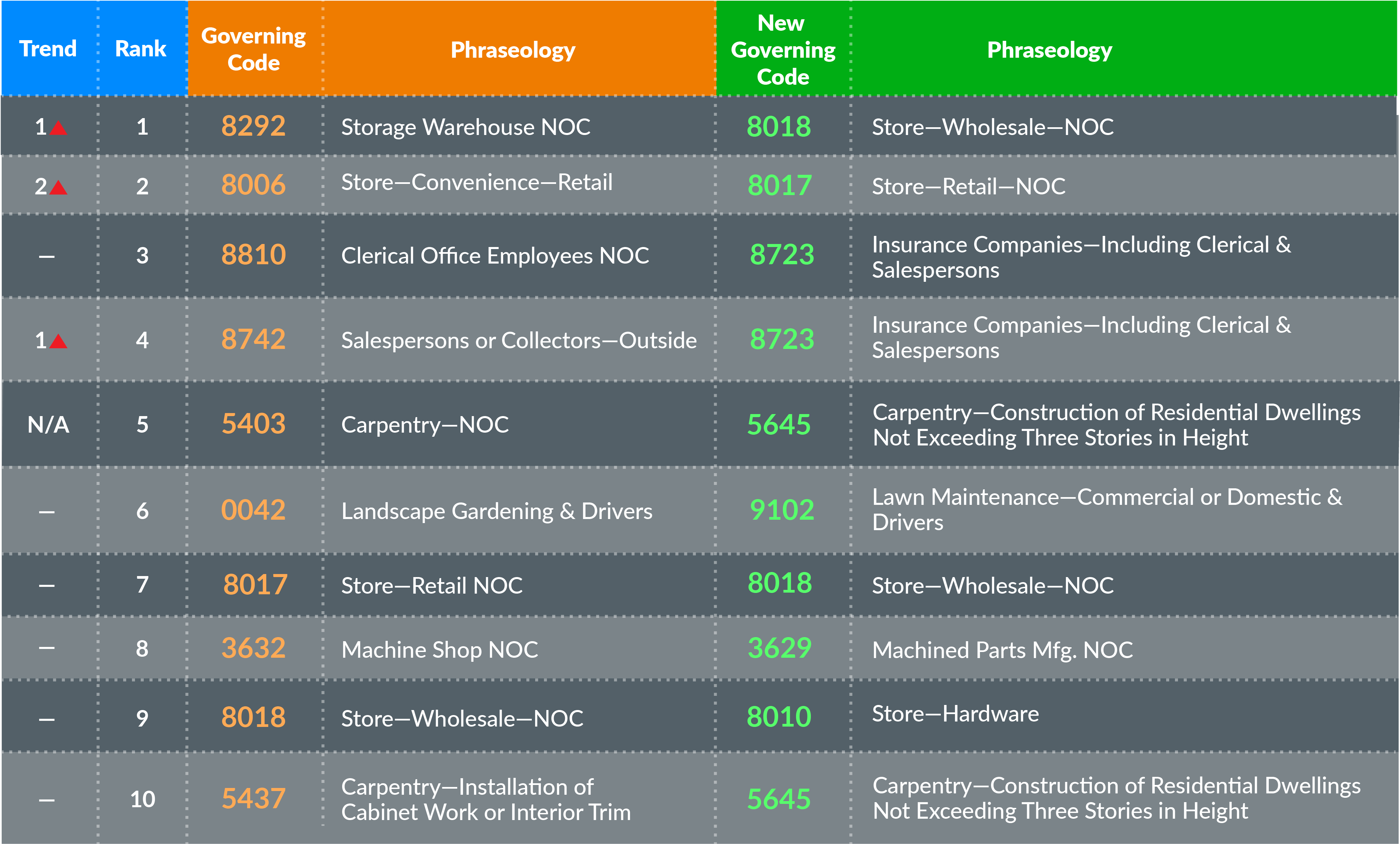
This article takes a deeper look at five of the top 10 reclassified codes, examining the common drivers behind each reassignment and highlighting what to look for at policy issuance to help prevent recurring misclassification.
Code 8292—Storage Warehouse NOC
Code 8292—Storage Warehouse NOC returned to the top position on NCCI’s Top Reclassified Codes list this year after ranking second last year, continuing its recent pattern as one of the most frequently reclassified governing classification codes.
While Code 8292 remains at the top of the list, the share of policies being reassigned has been gradually declining. In 2023, 60% of inspected policies with Code 8292 changed governing classification. That dipped slightly to 59% in 2024 and to 56% in 2025. Of the 56% of policies reclassified from Code 8292, 78% were reclassified to a mercantile code.
As a reminder, the governing classification code should reflect the employer’s overall business operations, not simply an individual task, location, or employee activity. Not otherwise classified (NOC) and standard-exception classifications may apply when the facts support their use, but they can be displaced when a more specific or more representative governing classification code better describes the employer’s business.
For more information on this, refer to NCCI’s
Basic Manual for Workers Compensation and Employers Liability Insurance (Basic Manual) rules for Governing classifications, Classification system purpose and application, and Classification words and phrases.
Reassignment of Code 8292 to a Mercantile Code
In 2023, 75% of policies in Code 8292 were reassigned to a mercantile code, increasing to 80% in 2024 and holding at 78% in 2025. Even as overall reassignment activity has decreased, changes continue to most often shift into the mercantile code. This pattern has remained consistent. Code 8018—Store—Wholesale—NOC was the most commonly reassigned governing code. This code alone accounted for 49% of the 78% that were reassigned to a mercantile classification code.
This inspection data indicates operations that initially appear to be storage companies often support a broader mercantile business. While Code 8292 may seem appropriate due to a warehouse setting, the building alone does not determine classification.
Think of a scenario with a business that stores its inventory in a large warehouse and ships orders daily. At first glance, it looks like a storage operation. In practice, the warehouse is supporting the employer’s primary business of selling and distributing its own products. In these cases, a mercantile classification is typically more appropriate.
Key Considerations
In cases where Code 8292 is reassigned, the most commonly overlooked factor is the distinction between passive storage and active order fulfillment. When reviewing a policy, consider the following:
- What is the overall nature of the employer’s business?
- Who holds equity to the goods being stored?
- Is the employer providing passive storage for goods owned by others, or is it actively fulfilling orders through pick/pack/ship operations?
- Are goods being repackaged, relabeled, assembled, or otherwise prepared for sale or distribution?
Those questions help separate a true storage warehouse from a business using warehouse space to support a broader sales, fulfillment, or distribution operation. The distinction between passive storage and active order fulfillment is especially relevant to inspection-based classification decisions.
For additional information on classification of these types of operations, refer to NCCI’s
Basic Manual rule, Classification system purpose as well as NCCI’s
Scopes® of Basic Manual Classifications
(Scopes® Manual) under Code 8292 and Code 8018.
Code 5403—Carpentry NOC
Code 5403—Carpentry NOC ranked fifth on this year’s NCCI’s Top Reclassified Codes list, which marks the first time Code 5403 has appeared since the inception of the top reclassified articles. The inspection data indicates there is a pattern in which carpentry work is present, but the employer’s overall business aligns more closely with another construction classification.
Inspection findings show that Code 5403 is often reassigned when carpentry is only one part of a broader construction operation. Approximately 29% of inspected policies assigned to Code 5403 resulted in a change to the governing classification and 83% of those reclassified policies were reassigned to construction or erection-related classifications.
Among the policies reassigned from Code 5403, Code 5645—Carpentry—Construction of Residential Dwellings Not Exceeding Three Stories in Height was the most common destination code. Code 5645 accounted for 23% of the reassignments with the remaining construction or erection-related classifications reassignments spread across 18 other class codes.
What’s Driving Reassignment From Code 5403
Inspection data shows a consistent pattern where employers assigned to Code 5403 are frequently performing carpentry work in residential settings rather than on larger commercial projects. Tasks such as framing, interior finishing, and repair work within single-family homes, additions, and remodeling jobs, indicate that a growing share of carpentry exposure is tied to residential construction activity. Narratives also reflect employees moving across multiple phases of residential work from structural builds to finish carpentry, highlighting that classification outcomes are increasingly driven by the actual duties observed in the field.
Consider the example of a contractor performing framing work on a multistory apartment complex. The tasks include cutting, installing, and assembling structural wood components. These operations could initially point to Code 5403. And in this case, that may actually be on the right track, but not just because it’s carpentry. Looking closer, Code 5403 isn’t just an NOC carpentry classification, it also serves as a project code for carpentry work on commercial buildings and residential structures exceeding three stories. Since the contractor’s work is tied to a multistory project, the classification aligns with both the type of work and the nature of the structure. Now contrast that with a contractor performing similar framing work on a two-story residential home. While the carpentry tasks may look nearly identical, the context changes the classification outcome. Here, the work is tied to the construction of a dwelling not exceeding three stories, which is what Code 5645 is specifically designed to capture as a project code.
Key Considerations
In cases where Code 5403 is reassigned, the most commonly overlooked factor is whether the carpentry work is tied to a broader residential construction operation or another more specific construction classification. When reviewing a policy, consider the following:
- What type of structure is the employer building?
- Does the employer’s work involve residential construction, commercial construction, or multiple trades?
- Is carpentry the employer’s primary business, or just one part of a broader construction operation?
Those questions can help distinguish a true Code 5403 carpentry operation from an employer whose overall business is more accurately described by another construction classification.
For examples on the above, refer to NCCI’s
Scopes® Manual under Code 5645 and Code 5403.
Code 3632—Machine Shop NOC
Code 3632—Machine Shop NOC ranked eighth on NCCI’s Top Reclassified Codes list, holding the same position as the prior year. The inspection data points to a pattern in which machining activity is present, but the employer’s overall business more closely fits a specific manufacturing or fabrication classification.
Inspection findings show that Code 3632 is often reassigned when machine shop work is only one part of a broader operation. Approximately 23% of inspected policies assigned to Code 3632 resulted in a change to the governing classification and those reassignments were concentrated in manufacturing, fabrication, and machining-related classifications.
Code 3629—Machined Parts Mfg. NOC was the most commonly reassigned governing code, accounting for approximately 15% of all reclassifications. Code 3040—Iron or Steel Fabrication—Ironworks—Shop—Ornamental & Drivers followed at 13% and Code 3612—Engine Mfg. NOC accounted for 9%.
Several other manufacturing classifications also appeared regularly, which suggests that reassignment is spread across a range of more specific manufacturing operations rather than concentrated in a single category.
One example of this reclassification is the shift from Code 3632 to Code 3629.
Why Code 3632 Is Often Reclassified
In many cases, Code 3632 is replaced not because machining is no longer performed, but because it is no longer the employer’s principal operation. As business models evolve toward producing finished products such as ornamental iron or steel fabrication Code 3040 or engine manufacturing Code 3612, the governing classification shifts from a process-based code to one that reflects the employer’s primary output.
This pattern is especially common because Code 3632 is an NOC (not otherwise classified) code. It is designed to capture general machine shop operations when no more specific classification applies. As operations become more defined and aligned with a particular manufacturing output, the business is often reclassified to a code that more precisely describes those activities.
Code 3632 captures general machine shop operations that may include assembly, fabrication, repair work, or a mix of processes. By comparison, Code 3629 is far more narrowly defined and applies only to employers engaged in machining single-piece parts for others, without any assembly or fabrication.
Consider a potential situation where a shop used to handle everything such as machining parts, doing some light assembly, maybe a little fabrication on the side. Over time, they streamline and focus strictly on CNC machining, producing stand-alone precision components that get shipped to other manufacturers for final use. Once they drop the assembly and fabrication pieces, the work begins to resemble true single-piece part production, aligning more closely with Code 3629 than a general machine shop classification.
Key Considerations
In cases where Code 3632 is reassigned, the most commonly overlooked factor is whether the operation is limited to machining single-piece parts for others or includes broader assembly, fabrication, repair, or finished-product manufacturing. When reviewing a policy, consider the following:
- Does the employer machine single-piece parts for others, with no assembly, fabrication, or repair operations performed?
- Is the operation limited to producing machined parts or does it include broader machine shop services such as assembly, fabrication, or repair work?
- If the employer manufactures a specific finished product, does another manufacturing classification more accurately describe the employer’s overall business?
These considerations make the Code 3629 eligibility test more explicit: Code 3629 is appropriate only when the operation is limited to machining single-piece parts for others and does not include assembly, fabrication, or repair. If those additional operations are present, or if the employer’s work supports a specific finished product, Code 3632 or another more specific manufacturing classification may better describe the employer’s overall business.
For more information on this, refer to NCCI’s
Scopes® Manual under Code 3632 and Code 3629.
Code 8810—Clerical Office Employees NOC and Code 8742—Salespersons or Collectors—Outside
Codes 8810—Clerical Office Employees NOC and 8742—Salespersons or Collectors—Outside continues to appear near the top of NCCI’s most reclassified governing codes, ranking third and fourth, respectively. However, the story behind these two codes is an ongoing trend. Unlike some of the other classifications in this year’s article, reclassification activity here is trending downward, an indication that classification practices are becoming more consistent over time.
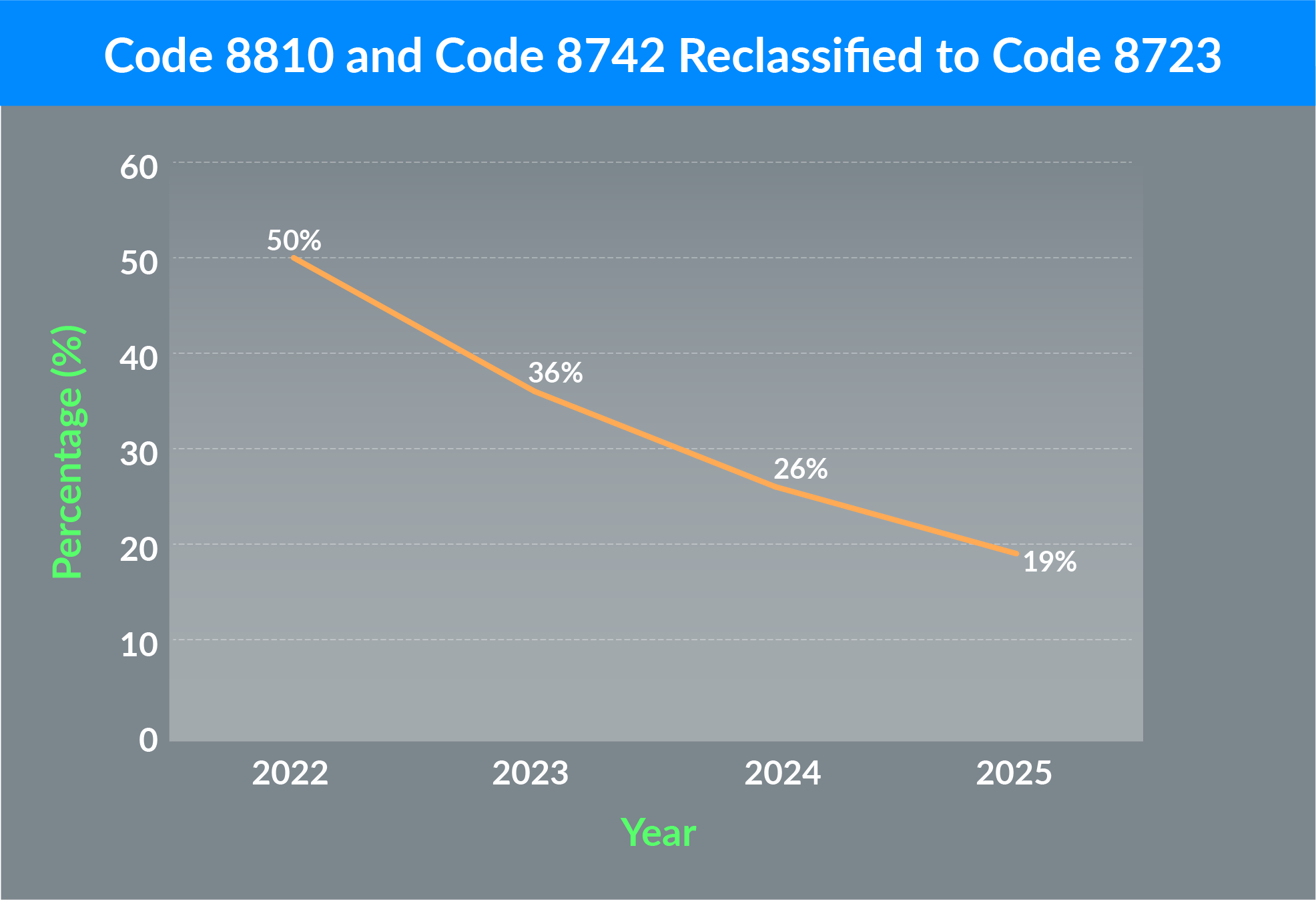
Recent inspection data shows that approximately 36% of policies assigned to Code 8810 or Code 8742 resulted in a change to the governing classification. Of those reclassified policies, a portion continued to move to Code 8723—Insurance Companies, Including Clerical & Salespersons. However, that reassignment pattern has steadily declined in recent years, dropping from 50% three years ago to 19% in the most recent period.
Understanding the Shift From Code 8810 and Code 8742 to Code 8723
Much of the reassignment activity between Code 8810, Code 8742, and Code 8723 can be traced to the introduction of Code 8723 for insurance companies. Carriers seeking additional guidance on this item may refer to the relevant underwriting circulars listed at the end of this article. The reclassification of employers from Code 8810 and Code 8742 to Code 8723 continues to reflect the impact of Item B-1419—Revisions to Basic Manual Classifications and Appendix E—Classifications by Hazard Group, which established Code 8723 for insurance companies. This reassignment still happens often, but less often than before, which suggests the classification change is now being applied more consistently.
Take, for example, an employer with a team of administrative staff handling policy servicing, underwriting support, and customer inquiries, along with employees responsible for selling insurance products in the field. At first glance, these roles may appear to fit standard clerical or outside sales classifications. But when those activities are performed as part of an insurance company’s overall business, the exposure is more accurately reflected by Code 8723 rather than Code 8810 or Code 8742.
Key Considerations
In cases where Code 8810 or Code 8742 are reassigned, the most commonly overlooked factor is whether clerical or outside sales employees are supporting a broader industry-specific business, such as insurance operations. When reviewing a policy, consider the following:
- What is the employer’s overall business? Does it involve insurance operations?
- Are clerical or outside sales employees supporting a broader insurance business?
- Do the employee duties reflect a general exposure or are they tied to a specific industry classification?
These considerations help distinguish when Code 8810 and Code 8742 appropriately apply versus when the employer’s operations are more accurately captured under an industry-specific classification such as Code 8723.
For additional information on classification of these types of operations, refer to NCCI’s
Basic Manual rule, Classification system purpose, Standard exception classifications as well as NCCI’s
Scopes® Manual under Code 8810, Code 8742, and Code 8723.
Notable Trends in Reclassified Codes
In addition to the codes that rose to the top of this year’s list, the 2025 data also showed improvement in an area that stood out in the prior year’s analysis. One of the clearest examples is Code 7380, which dropped off the list after a significant decline in reclassification activity.
Code 7380—Drivers, Chauffeurs, Messengers, and Their Helpers NOC—Commercial
In the prior year’s article, Code 7380 was ranked as the most reclassified governing code. That result reflected a consistent pattern where the code was being assigned to employers whose operations were not primarily transportation-related but instead, aligned more closely with mercantile businesses.
Inspection findings showed that more than 80% of policies assigned governing Code 7380 resulted in a change to the governing classification last year. More than half of those reclassified policies were reassigned to mercantile classifications, most often Code 8018—Store—Wholesale—NOC and Code 8010—Store—Hardware.
The issue was not the presence of delivery exposure itself. It was that delivery was often incidental to the employer’s primary business. In many of these cases, the employer was operating a wholesale or retail business and the governing classification needed to reflect the overall nature of the operation rather than employee movement alone.
That combination of frequent overuse and a high rate of correction at inspection is what drove Code 7380 to the top of the list in the prior year. This year, however, Code 7380 dropped off the list, suggesting that many of those prior reclassifications, particularly those involving wholesale and retail operations, are now being classified more accurately.
Underwriting Circulars
In addition to the top reclassified codes article, NCCI also releases various underwriting circulars on classification, trends, and other topics related to rules or forms to communicate and provide guidance for properly classifying business operations. These circulars are available for affiliates on
ncci.com.
Content Requires Authentication
-
Circular FYI-CW-2026-01: Countrywide—Establishment or Elimination of Multistate and State-Special Classifications From 2021 Through 2025
-
Circular FYI-CW-2025-04: Countrywide—Multistate Classification Item Filings Effective January 1, 2025, or After
-
Circular FYI-CW-2025-02: Countrywide—Scopes of Basic Manual Classifications—Content updates for Electronic nicotine delivery systems, Greenhouse vegetable growing, Handling fresh meats, Helicopter manufacturing, Landfills, Portable storage containers, and Tennis clubs
-
Circular FYI-CW-2025-01: Countrywide—The Impact of the Decimal Extension of Loss Costs, Rates, and Expected Loss Rates on NCCI Products
Class Look-Up Tool
NCCI’s
Class Look-Up tool allows users to look up classifications, statistical codes, and related filed and nonfiled content. Users can filter or refine results by selecting or deselecting specific code elements. The tool also provides a code and phraseology snapshot that includes information about the specific code selected and five years of rate history. This tool is free for use by authenticated users.
Summary
Assigning the appropriate classification code at policy issuance is an important step in maintaining the integrity of the classification system. NCCI’s
Basic Manual contains the filed and approved phraseology and notes for each classification code. NCCI’s
Scopes® of Basic Manual Classifications, a supplement to NCCI’s
Basic Manual, is a guide to understanding and assigning classifications. Using NCCI’s
Class Look-Up tool and manuals, in addition to asking appropriate questions regarding an employer’s operations, can greatly reduce the number of reclassified codes.
NCCI is sharing its cumulative findings to provide information about emerging trends identified within its Classification Inspection Program. The general code information provided includes examples of reclassification areas that were identified. Without a specific inspection to reference, NCCI can only provide general information on the codes involved.
If you have any questions, please contact our Customer Service Center at 800-NCCI-123 (800-622-4123) or email us at
customer_service@ncci.com. We’re here to assist you Monday–Friday, 8:00 a.m.–8:00 p.m. ET.
This article is provided solely as a reference tool to be used for informational purposes only. The information in this article shall not be construed or interpreted as providing legal or any other advice. Use of this article for any purpose other than as set forth herein is strictly prohibited.